
The Invisible Work We Carry: Understanding Emotional Labor, Mental Load, and the Cost of Caring

Emotional labor and mental load can leave people feeling exhausted, even when they appear to be doing fine. These invisible responsibilities often include managing emotions, anticipating needs, organizing daily life, and caring for others.
Why Do Invisible Responsibilities Feel So Exhausting?
Remembering the doctor’s appointment was just the start. After noticing a coworker seemed overwhelmed, checking in post-meeting came naturally. On top of that, reminding a teenager about homework and scheduling a parent’s follow-up filled the rest of the day—all while buying the birthday gift, planning dinner, answering endless questions, and keeping up a smile.
No one asked you to carry all of it.
Still, somehow, you did.
For millions of people, this invisible work happens every day.
It rarely appears on a calendar.
It usually isn’t listed on a job description.
Often, it isn’t even recognized by the people who benefit from it.
Yet it carries a real emotional cost.
Researchers increasingly recognize that these responsibilities can affect mental health, relationships, and overall well-being. Although invisible work looks different across families, workplaces, and cultures, one thing is clear:
Invisible work is still work.
Understanding Emotional Labor and Mental Load
People often use these terms interchangeably. However, emotional labor and mental load describe different experiences.
Emotional Labor
Sociologist Arlie Hochschild first introduced the concept of emotional labor to describe the effort required to manage or display emotions as part of paid work.
Think about:
- Nurses comforting anxious patients
- Teachers remaining calm during stressful situations
- Customer service representatives responding kindly to angry customers
- First responders maintaining composure during crises
Emotional labor requires people to regulate their emotions, even when their outward response does not match what they feel. This effort can become exhausting over time.4,5
Mental Load
Mental load refers to the invisible planning, organizing, anticipating, and remembering that keeps households, workplaces, and families functioning.
Examples include:
- Remembering birthdays
- Scheduling appointments
- Monitoring children’s emotional needs
- Planning meals
- Keeping track of medications
- Coordinating family schedules
- Anticipating problems before they happen
Unpaid Care Work
Unpaid care work includes the practical and emotional responsibilities involved in caring for children, aging parents, family members, neighbors, or loved ones without financial compensation.
Together, emotional labor and mental load can create an overwhelming burden that is difficult to describe.
What Does the Research Tell Us?
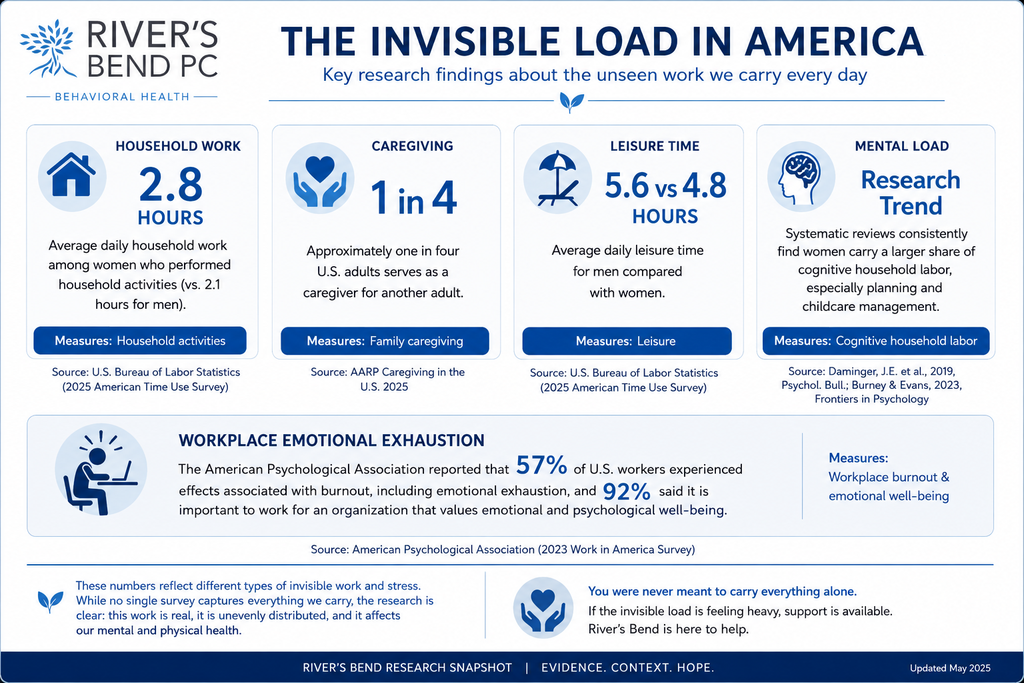
No single national survey measures every aspect of invisible work. Therefore, studying emotional labor can be challenging.
Instead, researchers examine related topics such as household responsibilities, caregiving, workplace emotional demands, and cognitive labor.
Taken together, the findings reveal several important patterns.
Gender
Research consistently shows that women perform a larger share of household management and cognitive labor than men.1,3
According to the U.S. Bureau of Labor Statistics, women continue to spend more time on household activities than men, while men generally report more leisure time.
Studies of mental load suggest that women often carry more responsibility for anticipating family needs. In addition, they may organize daily life and coordinate childcare even when household chores appear equally divided.1,2,3
This does not mean men do not experience emotional labor.
Many men carry significant emotional burdens related to financial responsibility, caregiving, leadership roles, military service, first responder work, or occupations that discourage emotional expression.
Rather than belonging to one gender, emotional labor simply tends to look different across people’s lives.
Age and Life Stage
Invisible work often increases during life’s busiest seasons.
Adults who raise children while supporting aging parents are often called the “sandwich generation.” They frequently describe feeling pulled in multiple directions.
National caregiving research estimates that approximately one in four American adults provides care for another adult, while many simultaneously manage careers, parenting responsibilities, finances, and relationships.
Older adults may experience increasing caregiving responsibilities, while younger adults often navigate workplace expectations alongside establishing households and families.
The common thread is not age.
It’s responsibility.
Race, Culture, and Community
Our experiences of emotional labor are also shaped by culture, family expectations, community responsibilities, and workplace environments.
Research suggests that individuals from historically marginalized communities may experience additional emotional demands associated with navigating discrimination, representing their communities, educating others, or managing bias in professional settings.
Cultural values can influence how families share invisible work. For example, expectations about caregiving, family loyalty, and intergenerational support may affect whether asking for help feels acceptable.
Every family’s story is different.
Understanding those experiences without making assumptions is an important part of compassionate behavioral healthcare.
Income and Resources
Financial resources can significantly influence emotional labor.
Higher-income households may have greater access to childcare, meal services, transportation, housekeeping, or eldercare support.
Lower- and middle-income households often carry many of these responsibilities themselves while balancing demanding work schedules and financial pressures.
Family caregivers frequently report financial strain, reduced work hours, and increased stress while supporting loved ones.
The challenge isn’t simply having more responsibilities.
It’s having fewer opportunities to set them down.
When Invisible Work Becomes Emotionally Heavy
Over time, chronic emotional labor can contribute to several challenges:4,5
- Anxiety
- Depression
- Burnout
- Sleep difficulties
- Irritability
- Compassion fatigue
- Relationship conflict
- Emotional exhaustion
- Feelings of resentment
- Difficulty relaxing
Many people continue functioning while quietly becoming overwhelmed.
They tell themselves:
- “Everyone feels this way.”
- “It’s just part of being a parent.”
- “I don’t have time to fall apart.”
But carrying invisible responsibilities without adequate support can gradually affect both mental and physical health.
Workplace burnout and emotional exhaustion can affect many professions, especially jobs centered on helping others. Learning to distinguish healthy rest from avoidance may help people respond to stress earlier.
Emotional Labor in the Workplace
- Healthcare professionals.
- Teachers.
- Social workers.
- First responders.
- Therapists.
- Administrative professionals.
- Customer service representatives.
- Leaders.
Many professions require employees to remain calm, compassionate, patient, and emotionally available regardless of what they themselves may be experiencing.
This emotional regulation is often expected, but rarely discussed.
Employee well-being depends on more than individual resilience. Healthy workplace cultures, psychological safety, supportive leadership, and realistic expectations also matter.
Supporting emotional health benefits both individuals and the organizations they serve.
Therapy Can Help Make the Invisible Visible
One of the greatest strengths of therapy is giving people language for experiences they have never fully understood.
Therapy cannot eliminate every responsibility.
But it can help people:
- Recognize unhealthy patterns of overfunctioning
- Identify unrealistic expectations placed on themselves
- Improve communication within relationships
- Develop healthier boundaries
- Reduce perfectionism
- Address anxiety and burnout
- Build healthier family systems
- Learn to ask for and accept support
- Separate self-worth from constant caregiving
Most importantly, therapy can help people remember one essential truth:
Therapy helps people remember that caring for others should not require losing themselves.
The goal is not to care less.
The goal is to make caring sustainable.
Supporting Families, Caregivers, and Professionals
Invisible work affects nearly every family in some way.
- Parents.
- Adult children.
- Healthcare professionals.
- Teachers.
- Employers.
- Caregivers.
- Students.
- Couples.
When we recognize emotional labor and mental load as real experiences, we can respond with greater understanding. As a result, we become better equipped to build healthier relationships, stronger workplaces, and more supportive communities.
Awareness is often the first step toward meaningful change.
Frequently Asked Questions
Emotional labor refers to the effort involved in managing or regulating emotions to meet the expectations of work or relationships. The term originally described workplace emotional demands but is now often used more broadly to describe invisible emotional responsibilities.
Emotional labor focuses on managing emotions, while mental load refers to the invisible planning, organizing, remembering, and anticipating needed to manage households, workplaces, or caregiving responsibilities.
Yes. Chronic emotional labor may contribute to anxiety, depression, burnout, compassion fatigue, emotional exhaustion, and relationship stress when adequate support and recovery are lacking.
Everyone can experience emotional labor. Research suggests the type and amount of invisible work often varies based on gender, occupation, caregiving responsibilities, family structure, culture, and available support systems.
Therapy helps individuals better understand emotional patterns, establish healthy boundaries, improve communication, reduce burnout, and develop strategies for creating more sustainable ways of caring for themselves and others.
You Don’t Have to Carry Everything Alone
Sometimes the hardest part of emotional labor is that no one sees it.
If invisible demands leave you exhausted, overwhelmed, or disconnected, you do not have to manage them alone. Support is available for stress related to work, caregiving, parenting, relationships, and daily life.
At River’s Bend, our clinicians understand that emotional well-being involves more than what appears on the surface. We help individuals, couples, and families develop healthier coping skills, strengthen relationships, and support lasting well-being.
Ready to lighten the load?
Contact the River’s Bend intake team to learn more about our therapy services. Personalized behavioral healthcare can help you create a healthier, more sustainable way to care for yourself and others.
References
1. Reich-Stiebert, N., Froehlich, L., & Voltmer, J.-B. (2023). Gendered Mental Labor: A Systematic Literature Review on the Cognitive Dimension of Unpaid Work Within the Household and Childcare. Sex Roles, 88, 475–494. DOI / publication
2. Daminger, A. (2019). The Cognitive Dimension of Household Labor. American Sociological Review, 84(4), 609–633. DOI / publication
3. Aviv, E., Waizman, Y., Kim, E., Liu, J., Rodsky, E., & Saxbe, D. (2025). Cognitive household labor: gender disparities and consequences for maternal mental health and wellbeing. Archives of Women’s Mental Health, 28(1), 5–14. DOI / publication
4. Humphrey, N. M. (2023). Emotional labor and employee outcomes: A meta-analysis. Public Administration, 101(2), 422–446. DOI / publication
5. Yin, Y., Sun, S., Song, L., Jin, C., & Wang, Y. (2023). Emotional labour strategies and job burnout: A meta-analysis of Chinese employees. Asian Journal of Social Psychology, 26, 219–237. DOI / publication