The Emerging Substance-Use Landscape: What Families and Professionals Should Know

Kratom, 7-OH, high-potency cannabis and other unfamiliar substances are changing conversations about substance use. River’s Bend President Bruce Goldberg and business development representative Tana Lewis share what families and professionals should understand.
A parent discovers an unfamiliar product in their college student’s room. A therapist hears a client mention kratom but isn’t certain what they’re taking. Someone calls a behavioral-health clinic because a loved one’s behavior has changed, but they don’t know whether substance use is involved.
These situations share an important challenge: recognizing a problem can be difficult when the substances themselves are unfamiliar.
For decades, substance-use conversations have included alcohol, cocaine, heroin, prescription medications and other well-known drugs. Those substances remain important concerns. But today’s landscape also includes highly concentrated cannabis products, kratom-derived compounds, novel synthetic drugs and products marketed through smoke shops, gas stations and online retailers.
Some are sold in packaging that looks more like candy or a wellness supplement than a substance capable of causing harm.
For families and professionals, understanding what’s changing is increasingly important.
But according to Bruce Goldberg, LMSW, CAADC, SAP, and Co-Owner of River’s Bend, identifying a substance is only part of the picture.
The larger question is what the person is using, how it is affecting them and what kind of help they may need.
A Changing Landscape: Familiar Substances, Unfamiliar Products
Goldberg has worked in behavioral health and substance-use treatment for decades. Asked what feels different today, he pointed to the growing variety of substances and combinations people may encounter.
“It’s not your traditional drugs,” Goldberg said.
He described a landscape in which newer formulations, mixed substances and uncertainty about product contents can complicate treatment conversations.
Among the substances he identified as important concerns were kratom, xylazine, high-potency THC and delta-THC variants.
These substances aren’t all new, nor do they carry identical risks. What has changed is the variety of products available, how some are formulated and marketed, and how much consumers may—or may not—know about what they’re taking.
Tana Lewis, a new member of River’s Bend’s business development team, has also witnessed changes through her years working in behavioral-health and substance-use treatment settings.
She remembers a time when conversations about drug access often centered on substances purchased through illicit markets.
Today, she says, the conversation is broader.
“Now it’s so many different synthetic drugs and different ways,” Lewis explained, describing products accessed online, at smoke shops and at other retail locations.
Her concern isn’t simply where products are purchased. It’s that familiar retail environments can influence how people perceive their safety.
When Availability Creates a False Sense of Security
A product doesn’t necessarily feel dangerous when it comes in a brightly colored package.
It may be advertised as natural, plant-based or available without a prescription. It may resemble candy, a beverage, a supplement or an ordinary vaping product.
Those presentations can shape how people understand risk.
Goldberg raised concerns about the accuracy of product labeling and the uncertainty surrounding some newer or less-regulated products.
For Lewis, the accessibility and appearance of certain products are especially concerning for young people.
She described seeing cannabis products offered in forms resembling cookies, candy and other familiar foods.
The distinction matters because commercial availability is not the same as medical approval, consistent product quality or freedom from risk.
A substance can come from a plant and still have powerful effects. A product can be sold openly and still carry risks of dependence, intoxication or other health consequences.
And a package’s appearance doesn’t necessarily tell someone how concentrated its active ingredients are.
Kratom and 7-OH: Why the Exact Product Matters
Kratom is a plant native to Southeast Asia that contains compounds capable of interacting with opioid receptors.
Products marketed as kratom can differ considerably. Some contain ground plant material, while others are concentrated extracts or products containing elevated amounts of specific compounds.
One substance receiving particular attention is 7-hydroxymitragynine, commonly called 7-OH.
7-OH occurs naturally in kratom in relatively small amounts, but concentrated 7-OH products can expose consumers to substantially different amounts than traditional kratom leaf preparations.
These distinctions are important because the word kratom alone may not adequately describe what someone is taking.
River’s Bend Practice Manager Amy Buchanan reported hearing more inquiries about 7-OH than usual in October 2026. This observation describes inquiries, not confirmed diagnoses or how common 7-OH use is in the community.
Lewis also described encounters in her previous work with people who had turned to other substances while attempting to stop using something else.
That history can complicate the situation. A person may initially believe they are managing a problem, only to develop a new pattern of use that becomes difficult to control.
For professionals, a useful conversation may begin with questions such as:
- What is the exact name of the product?
- Is it kratom leaf, an extract or a concentrated 7-OH product?
- How frequently is it being used?
- Has the amount increased?
- What happens when the person tries to stop?
- Is it being used alongside alcohol, medications or other substances?
The answers may be more informative than the product category alone.
High-Potency Cannabis: Today’s Products Are Different
Cannabis is another area where product strength and formulation deserve closer attention.
During a recent educational presentation for UAW representatives and Employee Assistance Program professionals, Goldberg focused on high-potency cannabis and its relationship to mental health.
One of the presentation’s central messages was straightforward:
Today’s cannabis is not yesterday’s cannabis.
Cannabis products now include high-concentration THC extracts, vape cartridges, edibles and other formulations that may deliver substantially different amounts of THC than traditional cannabis flower.
A systematic review of cannabis potency research found associations between higher-potency cannabis use and psychosis and cannabis use disorder. Findings for anxiety and depression were less consistent.
These findings require careful interpretation. Observational associations do not establish that cannabis causes every mental-health outcome studied, and individual risk varies.
Nevertheless, potency is an important consideration when assessing someone’s substance use, especially when they are also experiencing anxiety, depression, changes in perception or other psychiatric symptoms.
Lewis described seeing patients in her previous treatment setting who experienced significant difficulties related to cannabis use, including problems when attempting to stop.
Her experience reinforces an important point: a familiar substance can present unfamiliar challenges when its strength, formulation or pattern of use changes.
For clinicians, asking only whether someone uses marijuana may not provide enough information.
The product, potency, frequency, route of use and relationship to mental-health symptoms all deserve attention.
Emerging Synthetic Substances and Uncertainty About Exposure
Other substances can create a different challenge: people may not know exactly what they have consumed.
Goldberg identified xylazine as one of the substances professionals should recognize as the drug supply changes.
Xylazine is a veterinary sedative that has been found in the illicit drug supply, sometimes in combination with opioids. It is not approved for human use.
Unlike kratom or commercially marketed cannabis products, xylazine illustrates the danger of unexpected substances appearing in a drug supply.
Emerging synthetic opioids and other novel compounds create additional concerns because their effects, potency, combinations and detection may be poorly understood.
Cychlorphine, also called N-propionitrile chlorphine, is one emerging synthetic opioid named in the DEA’s May 2026 advisory. It is distinct from xylazine, which is a non-opioid sedative. Reports of unexpected exposure and overdose make it important to recognize, while its prevalence in individual communities remains uncertain.
For someone experiencing an unexpected reaction, identifying the substance may be difficult.
For clinicians, a negative routine drug screen does not necessarily exclude exposure to an emerging substance. Testing capabilities vary, and some compounds require specialized methods.
The practical lesson is that clinical symptoms, reported product use, medical history and appropriate testing all matter.
When an individual appears severely intoxicated, has difficulty breathing, cannot be awakened or shows other signs of a medical emergency, immediate emergency assistance is necessary.
What Families Might Notice Before They Know What’s Being Used
Families rarely begin with a complete understanding of a substance.
More often, they notice changes.
Goldberg identified several patterns that may warrant a closer conversation:
- Withdrawal from friends or family
- Changes in hobbies and interests
- Missing work or other responsibilities
- Financial difficulties
- Unexplained weight changes
- Unusual fatigue
- Increased avoidance
- Anxiety, depression or other noticeable mood changes
None of these signs, individually, proves that someone has a substance-use disorder.
They may also reflect mental-health concerns, physical illness, stress or other circumstances.
But changes in behavior and functioning can be reasons to ask questions rather than dismiss a concern.
Lewis emphasized the importance of being willing to have difficult conversations, even when the answers may be uncomfortable.
Her experience working with families has shown her that people sometimes hesitate to ask directly about drinking, drug use or emotional distress.
Yet those questions may be necessary to understand what someone is experiencing.
The goal isn’t to catch someone doing something wrong.
Families looking for a fuller discussion of support and boundaries can explore Helping Without Hurting.
It’s to create an opportunity for an honest conversation.
Why Better Questions Matter More Than Knowing Every Drug Name
The expanding substance-use landscape can feel overwhelming for parents, therapists, physicians, school professionals and other people trying to help.
No one can reasonably be expected to recognize every product name, formulation or emerging compound.
But they can ask better questions.
Goldberg explained that the assessment conversation needs to consider not only what someone has used but also the amount, frequency and their perception of the substance.
That last point can be particularly revealing
- Does the person believe the product is harmless because it is natural?
- Do they consider it safe because they bought it at a store?
- Do they recognize that their use has changed?
- Do they feel dependent on it?
Goldberg also emphasized a less confrontational approach.
“Very often leading the question open allows them to talk and speak more freely and truly share what they’ve used,” he said.
This reflects the value of motivational interviewing: an approach that emphasizes collaboration, curiosity and understanding someone’s perspective rather than relying primarily on confrontation.
For professionals, that might mean asking:
- “Tell me what you’re taking and what it does for you.”
- “What concerns, if any, have you had about using it?”
- “Have you noticed changes in how much you need?”
- “What happens when you go without it?”
For families, the conversation may begin even more simply:
“I’ve noticed some changes, and I’m worried about you. Can we talk about what’s happening?”
Goldberg encouraged parents to approach these discussions from a place of love and concern rather than punishment.
Assessment: Understanding the Person, Not Just the Substance
When someone seeks help, identifying the substance is important. But it doesn’t answer every clinical question.
A comprehensive assessment may also explore physical and mental-health symptoms, patterns of use, possible withdrawal, safety concerns, functioning, motivation and available supports.
Goldberg described asking how much and how often a person is using, along with when they last went without the substance. These questions can help determine whether medical evaluation or withdrawal management may need to come before outpatient therapeutic treatment.
Toxicology testing may also be considered when clinically appropriate, while recognizing that no single routine screen detects every substance.
The purpose is not simply to assign a diagnosis.
It’s to understand the situation well enough to identify an appropriate next step.
As Goldberg explained:
“We have to understand what we’re dealing with first to know if we’re the right level of care, or we need to refer to another level of care.”
That distinction is important.
Someone may benefit from outpatient therapy. Another person may require more structured treatment, medical withdrawal management or emergency care.
The right recommendation depends on the individual—not simply the name of the substance.
That is part of treating the whole person: considering substance use alongside mental health, medical needs, relationships and daily life. Our substance abuse evaluation guide explains what that conversation may cover.
When structured outpatient treatment is appropriate, a Substance Use Disorder Intensive Outpatient Program (IOP) or Mental Health Intensive Outpatient Program (IOP) may be considered. Specialized IOP programming helps explain why clinical fit matters within a level of care.
If you are unsure what kind of help is needed, you can start a conversation with River’s Bend about a non-emergency concern.
For Behavioral-Health Professionals: Staying Connected Matters
The changing drug landscape is also a reminder that professional education cannot happen in isolation.
Goldberg encouraged therapists, physicians, school professionals and other referral partners to remain informed about emerging substances and communicate with other treatment organizations.
He specifically recommended collaborative conversations with other facilities to better understand what professionals are encountering.
Lewis sees those relationships as an important part of helping people navigate treatment.
In her new role with River’s Bend, she is focused on strengthening connections with other providers and community organizations.
She recognizes that not every person who contacts River’s Bend will need the services it provides.
“Everyone is not going to be a good fit for River’s Bend,” Lewis said.
Her priority is helping people find an appropriate resource, whether that means River’s Bend or another provider.
This is particularly important when someone is using an unfamiliar substance, experiencing co-occurring mental-health symptoms or struggling to determine what level of care may be appropriate.
Strong referral relationships allow professionals to share knowledge, discuss options and help people move toward suitable care.
Read more about why referral partners trust River’s Bend and how communication supports care navigation.
Continue the Conversation at Michigan Presents
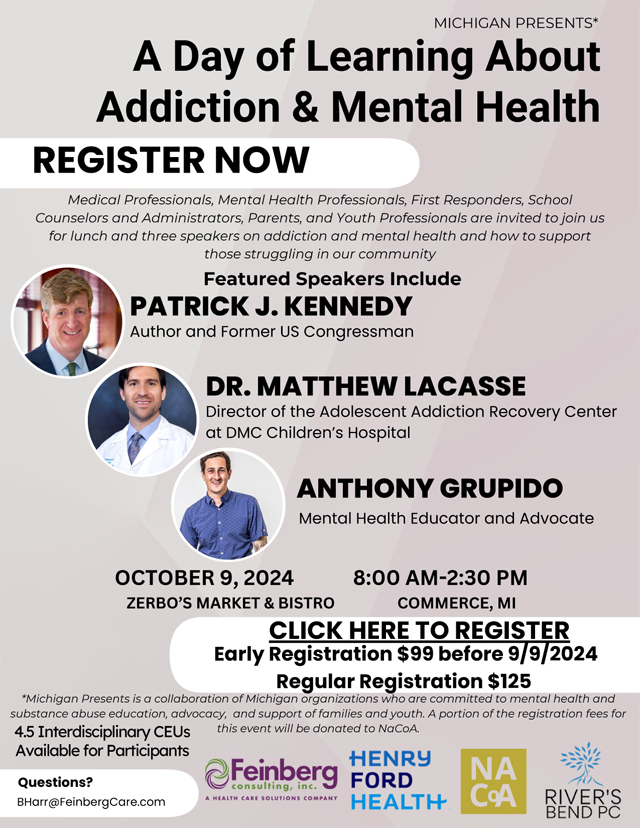
Michigan Presents brings behavioral-health and community professionals together December 3–4, 2026, in Metro Detroit. Its focus on education and professional connection complements the conversations in this series.
The event offers an opportunity for continuing education and professional collaboration—two important parts of responding thoughtfully to changing behavioral-health needs.
[EDITORIAL CHECK — EVENT — Confirm the December 4 Kingsley schedule, invitation-only December 3 dinner and River’s Bend participation wording before adding those specifics. The organizer confirms December 3–4 and Metro Detroit.]
You Don’t Have to Know Everything Before Asking for Help
The names and formulations of substances may continue to change.
But one principle remains constant: people deserve to be heard, understood and connected with appropriate care.
If you’re worried about someone you love, you don’t need to identify every substance before reaching out.
If you’re a professional encountering an unfamiliar product, you don’t need to have every answer before seeking consultation or making a referral.
And if you’re personally struggling with substance use, you don’t have to wait for a crisis to begin a conversation.
River’s Bend can help you explore what you’re experiencing, understand available options and identify a possible next step—even when the most appropriate resource is somewhere else.
You don’t need to know exactly where to start. You just need somewhere to begin.
Talk With the River’s Bend Team
References
- FDA — Products Containing 7-OH Can Cause Serious Harm
- FDA — FDA and Kratom
- Petrilli et al. — Cannabis potency, mental health and addiction, systematic review, 2022. DOI 10.1016/S2215-0366(22)00161-4
- DEA — Public Safety Advisory, May 12, 2026
- Professional perspectives: River’s Bend interviews with Bruce Goldberg and Tana Lewis, October 6, 2026. Interview experience is distinct from published research.