
Kratom, 7-OH and the Confusion Between “Natural” and “Safe”
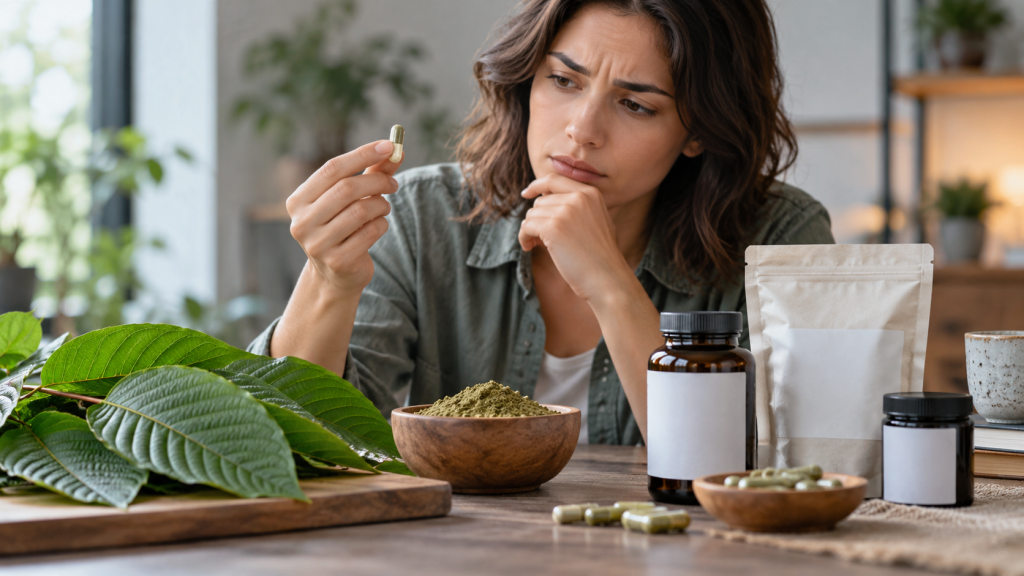
When a substance comes from a plant, is sold in a store or is marketed as a wellness product, it can be easy to underestimate its risks. River’s Bend President Bruce Goldberg and business development representative Tana Lewis explain why understanding the product—and the person using it, matters.
A product is advertised as natural.
It comes from a plant. It can be purchased without a prescription. Perhaps a friend recommended it for relaxation, pain or relief from uncomfortable symptoms.
It doesn’t look like what many people imagine when they think about addiction.
So how dangerous could it be?
That question is becoming increasingly important as families and behavioral-health professionals encounter products containing kratom and its related compounds, including concentrated 7-hydroxymitragynine, commonly known as 7-OH.
The challenge isn’t simply that unfamiliar substances are entering the marketplace. It’s that the language used to describe them—natural, herbal, plant-based, available over the counter—can influence how people understand their safety.
For Bruce Goldberg, LMSW, CAADC, SAP, Co-Owner of River’s Bend, the starting point is understanding what a person is actually taking and how they perceive the risks.
Because a substance’s origin doesn’t tell the whole story.
What Is Kratom, and Why Do People Use It?
Kratom comes from the leaves of Mitragyna speciosa, a tree native to Southeast Asia.
Its leaves contain naturally occurring compounds, including mitragynine and 7-hydroxymitragynine, that interact with opioid receptors.
People report using kratom for different reasons. Some seek increased energy or relaxation. Others use it in an attempt to manage pain, anxiety or symptoms associated with opioid withdrawal.
These motivations are important to understand.
Someone using kratom may not think of themselves as engaging in risky substance use. They may believe they’re choosing a plant-based alternative to another medication or substance.
Some may be trying to solve a problem they haven’t been able to address elsewhere.
But kratom has not been approved by the FDA to treat pain, anxiety, opioid withdrawal or any other medical condition.
Research into its potential effects and risks continues, including questions about dependence, withdrawal and the differences among commercially available products.
The important point is that a person’s reason for using kratom may be understandable without making the product itself safe or medically proven.
Natural Does Not Mean Risk-Free
The word natural often carries reassuring associations.
People may connect it with wellness, traditional remedies or a gentler alternative to manufactured medications.
But many naturally occurring substances have powerful biological effects.
Kratom is no exception.
Its active compounds interact with receptors involved in pain perception and other functions. Depending on the product, amount and individual, people may experience effects that include stimulation, sedation or opioid-like effects.
Regular use can also lead to physical dependence in some individuals, and withdrawal symptoms have been reported.
The FDA’s kratom guidance describes dependence, withdrawal and reported substance-use disorder concerns, while noting that important questions about kratom’s effects remain unanswered.
This uncertainty is itself a reason to approach broad safety claims cautiously.
A product’s plant origin does not establish its safety, appropriate dosage, consistency or effectiveness.
And when kratom is processed into concentrated extracts or enhanced formulations, the distance between the original plant and the product being consumed may become even more significant.
Kratom and 7-OH Are Not Interchangeable
One of the most important distinctions for consumers and professionals is the difference between traditional kratom leaf and concentrated 7-OH products.
7-hydroxymitragynine occurs naturally in kratom in relatively small amounts.
However, some products sold today contain added, enhanced or concentrated levels of 7-OH.
These may be marketed as tablets, gummies, drink mixes or liquid shots.
Because 7-OH has potent opioid activity, concentrated products raise particular concerns about dependence, withdrawal and other serious health effects.
The FDA has specifically distinguished its warnings about concentrated 7-OH products from traditional kratom leaf. The agency advises consumers to avoid products containing added or enhanced 7-OH because they have not been demonstrated to be safe or effective.
That does not mean traditional kratom products are risk-free. The FDA also warns against kratom use because of potential serious adverse effects.
It means the risks cannot be understood accurately by treating every kratom-related product as the same substance.
For someone seeking help, the exact product matters.
A clinician may need to know whether a person is using powdered leaf, an extract or a product containing concentrated 7-OH.
Even when someone knows the brand name, the label may not provide a complete picture of the product’s contents.
Questions to Ask About a Product
- Is it leaf powder, an extract or an enhanced 7-OH formulation?
- What active ingredients and amounts are listed per serving?
- What does the seller claim it will help with?
- What remains unclear about the contents?
A label can help start a conversation, but it cannot certify that a product is safe, accurately labeled or appropriate for a particular person.
“But You Can Buy It at a Store”
Accessibility can influence perception.
A product sold online or at a smoke shop may feel different from a substance purchased through an illicit market.
It may have a professional-looking label, colorful packaging or familiar branding.
For some consumers, those details create an impression of legitimacy.
Tana Lewis, a member of River’s Bend’s business development team, has witnessed substantial changes in substance use and accessibility during her years working in addiction treatment.
In a recent interview, she described how people once associated obtaining certain substances primarily with street-level purchases.
Today, she says, the landscape looks different.
“Now it’s so many different synthetic drugs and different ways from off the internet, from the smoke shops,” Lewis explained.
Although kratom itself is plant-derived rather than synthetic, her observation illustrates a broader change: consumers can encounter products with significant psychoactive effects in ordinary commercial settings.
The FDA has warned that concentrated 7-OH products are being sold through online retailers, smoke shops, gas stations and convenience stores.
Their availability should not be confused with FDA approval or proof of safety.
In fact, the agency has taken enforcement action against companies marketing certain concentrated 7-OH products unlawfully.
For families, this creates a challenge.
Someone may sincerely believe a product is safe because it was purchased openly.
But where a product is sold is not a reliable measure of what it does inside the body.
When Someone Is Trying to Stop Using Something Else
Not everyone who uses kratom is looking for intoxication.
Some people begin using it because they’re trying to manage pain or reduce their use of another substance.
That motivation deserves attention.
Lewis has encountered this pattern during her career in substance-use treatment.
“A lot of times they’re trying to get off of something else,” she said when discussing kratom-related products and other substances people may turn to.
In some cases, she explained, the substitute substance becomes another source of problematic use.
This can create a particularly confusing situation for families.
A loved one may say they’re making a healthier choice because they’ve stopped using something else.
And they may genuinely believe it.
But substituting one substance for another without appropriate medical guidance can introduce new risks, especially when the replacement product contains concentrated opioid-active compounds.
Kratom and concentrated 7-OH products are not FDA-approved treatments for opioid withdrawal or opioid use disorder.
Evidence-based treatments for opioid use disorder, including medications such as buprenorphine and methadone, are available through qualified providers.
Rather than dismissing someone’s motivation, a more productive conversation might begin with:
“What were you hoping this product would help you with?”
That question can reveal the problem the person is trying to solve.
And it can open the door to discussing safer, evidence-based options.
Why River’s Bend Asks About Risk Perception
For Bruce Goldberg, the product’s name is only part of the assessment. He also asks about the amount, frequency and what the person believes about its safety.
He described that third consideration as understanding “their perception of the safety and whether they feel safe, whether they feel dangerous.”
Someone who believes a product is harmless may not recognize escalating use as a concern. Another person may experience withdrawal without connecting it to a product they thought was natural. A third may be reluctant to discuss use because they do not consider the product a drug.
Understanding those beliefs helps clinicians ask questions that go beyond the product label.
How to Talk About Kratom Without Starting an Argument
Families often encounter a difficult balance.
They want to communicate concern, but they don’t want the conversation to become a debate about whether a substance is natural, legal or dangerous.
Goldberg recommends an approach grounded in curiosity rather than confrontation.
Discussing changes in substance-use assessment, he explained:
“Very often leading the question open allows them to talk and speak more freely and truly share what they’ve used.”
This approach reflects principles of motivational interviewing, which emphasizes collaboration, open-ended questions and understanding the individual’s perspective.
Instead of beginning with “That stuff is dangerous, and you need to stop,” a family member might ask:
- What made you interested in trying kratom?
- What do you like about how it makes you feel?
- Have you noticed needing more than you used to?
- What happens when you go without it?
- Have you tried cutting back?
- Is there something you’re struggling with that this product seems to help?
These questions are not meant to minimize risk.
They’re meant to make an honest conversation more possible.
For a young adult who believes a store-bought product is safe, listening first may help reveal information that a confrontation would never uncover.
When Use Becomes a Concern
Not every person who tries kratom develops a substance-use disorder.
But patterns of use and changes in functioning deserve attention.
Some warning signs may include using more than intended, unsuccessful attempts to cut back, cravings, withdrawal symptoms, continued use despite consequences or increasing reliance on the product to manage daily life.
Families may notice changes before they know what substance is involved.
Goldberg identified several broader indicators that may warrant a conversation, including work absenteeism, changes in interests, withdrawal from relationships, financial difficulties, fatigue and mood changes.
These signs are not unique to kratom or 7-OH.
They can also reflect mental-health concerns, medical conditions or other life circumstances.
But they can be reasons to seek a fuller understanding of what’s happening.
Our Helping Without Hurting resource offers guidance on responding with care and boundaries before someone is ready for treatment.
For someone using kratom-related products regularly, a professional assessment can help clarify whether dependence, withdrawal or another concern is present.
Why the Product Label Isn’t Enough for an Assessment
Someone may report using kratom without knowing its formulation or concentration. An assessment explores the product, amount and frequency of use, reasons for taking it, symptoms when stopping, other substances and changes in mental or physical health.
Goldberg emphasizes identifying medical needs before assuming outpatient therapeutic care is appropriate. As he explained:
“We have to understand what we’re dealing with first to know if we’re the right level of care, or we need to refer to another level of care.”
Our substance abuse evaluation guide explains that starting point. Substance Abuse Evaluations and Level of Care Evaluation provide more information about assessment pathways.
For non-emergency concerns, begin a conversation with River’s Bend about what has changed and what support may fit.
A Better Conversation About Safety
The distinction between natural and safe extends well beyond kratom.
It applies to supplements, concentrated extracts, high-potency cannabis products and other substances marketed in ways that can influence consumers’ perceptions.
A familiar plant name can conceal meaningful differences in the formulation a person actually uses.
Lewis’s experience highlights another part of the picture: products are increasingly accessible, and people may turn to them for reasons that aren’t immediately obvious.
Together, those perspectives suggest a more useful set of questions.
Not simply:
- Is it natural?
- Is it legal?
- Can I buy it at a store?
But:
- What is actually in this product?
- What effect is it having on the person using it?
- Has their use changed over time?
- And what support might they need?
Those questions create a more meaningful starting point for families, professionals and individuals seeking help.
You Don’t Have to Know the Product to Start Asking Questions
The substance-use landscape will continue to evolve.
New formulations, product names and marketing strategies can make it difficult to keep up.
But families don’t have to become experts in every emerging substance before asking for help.
And people who are struggling don’t need to know whether their experience meets the definition of addiction before reaching out.
At River’s Bend, the focus begins with understanding the person: what they’re experiencing, what they’re using, what concerns have emerged and what level of support may be appropriate.
Sometimes that support may be available through River’s Bend. Sometimes another provider or level of care will be a better fit.
That whole-person approach may lead to individual care or structured support such as a Substance Use Disorder Intensive Outpatient Program (IOP). Specialized IOP programs illustrate why clinical fit matters.
Either way, the conversation matters.
Because understanding what you’re seeing is often the first step toward finding the right help.
References
- FDA — FDA and Kratom
- FDA — Products Containing 7-OH Can Cause Serious Harm
- FDA — Hiding in Plain Sight and current 7-OH updates
- Professional perspectives: River’s Bend interviews with Bruce Goldberg and Tana Lewis, October 6, 2026. Interview experience is distinct from published research.